
You Won’t Believe This Florida Traffic Stop
How a vague statute led to a wrongful arrest

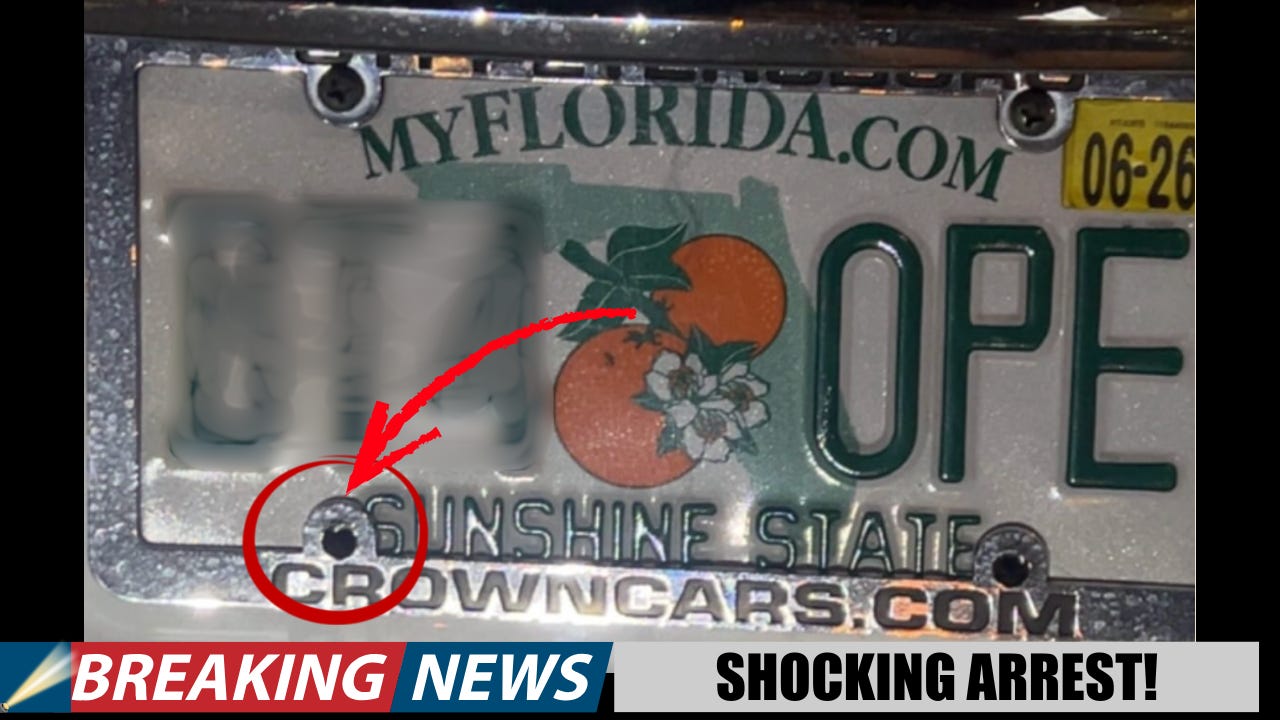
It starts with something almost nobody thinks could put them in jail.
A license plate frame.
In December 2025, Demarquize Dawson was driving a rental car through Davie, Florida, when police pulled him over. The reason wasn’t speeding. It wasn’t reckless driving. It wasn’t expired registration.
It was that a thin plastic frame on the rental car’s license plate partially covered the letter “S” in the words “Sunshine State.”
That one letter was enough to put him in handcuffs.
Dawson was arrested on the spot and spent the night in jail. Not for a civil citation. Not for a fix-it ticket. He was charged under Florida’s new license plate law, House Bill 253, which took effect October 1, 2025.
And here’s where this story gets dangerous.
HB 253 upgraded license plate violations from a noncriminal infraction to a second-degree misdemeanor. That means jail time. Criminal record. Arrest powers. All over a plate that is allegedly “obscured.”
But what exactly does “obscured” mean?
At the time Dawson was arrested, nobody could answer that clearly, including the police enforcing it.
Officers believed the frame violated the law because it partially covered the “Sunshine State” slogan. That belief was wrong.
After Dawson spent a night behind bars, the Davie Police Department publicly admitted the arrest should never have happened. They called the statute vague, unclear, and open to misinterpretation. They apologized. And they quietly updated officer training.
Even more important, the Florida Highway Safety and Motor Vehicles stepped in to clarify the law.
Their guidance was blunt.
License plate frames are allowed as long as they do not cover the alphanumeric characters or the registration decal. The words “Sunshine State” are not a primary identifier. Covering them is not a crime.
In other words, Dawson never should have been arrested.
But the damage was already done.
He lost his freedom for a night. He was booked. Fingerprinted. Jailed. And this all happened because of a law that changed quietly, was poorly explained, and was enforced incorrectly.
Now here’s why this matters to you, and this is where the insurance angle comes in.
When laws change suddenly, enforcement doesn’t always change correctly. And when enforcement goes wrong, regular people pay the price first.
If this traffic stop had escalated, if there had been a use-of-force incident, if Dawson had been injured, or if the rental company got dragged into a lawsuit, the question wouldn’t be who was right.
The question would be who is insured, and who is exposed.
Most drivers assume their auto policy covers everything. It doesn’t.
Most people renting cars assume the rental company has it handled. Sometimes they don’t.
And most people never think a minor traffic issue could turn into an arrest, legal fees, lost wages, or a civil claim. Until it does.
This case is a reminder that risk doesn’t always come from bad behavior. Sometimes it comes from bad interpretation.
From an insurance standpoint, this is exactly why liability coverage, legal defense provisions, and umbrella policies matter. Because when the system makes a mistake, you don’t want to be paying for it out of pocket.
Laws will keep changing. Enforcement will keep evolving. And mistakes will keep happening.
The only real question is whether you’re protected when they do.
If you have questions about auto coverage, rentals, liability limits, or how policy language responds when things go sideways fast, that’s what we help with.
Because sometimes all it takes is one letter on a license plate to change your life overnight.
