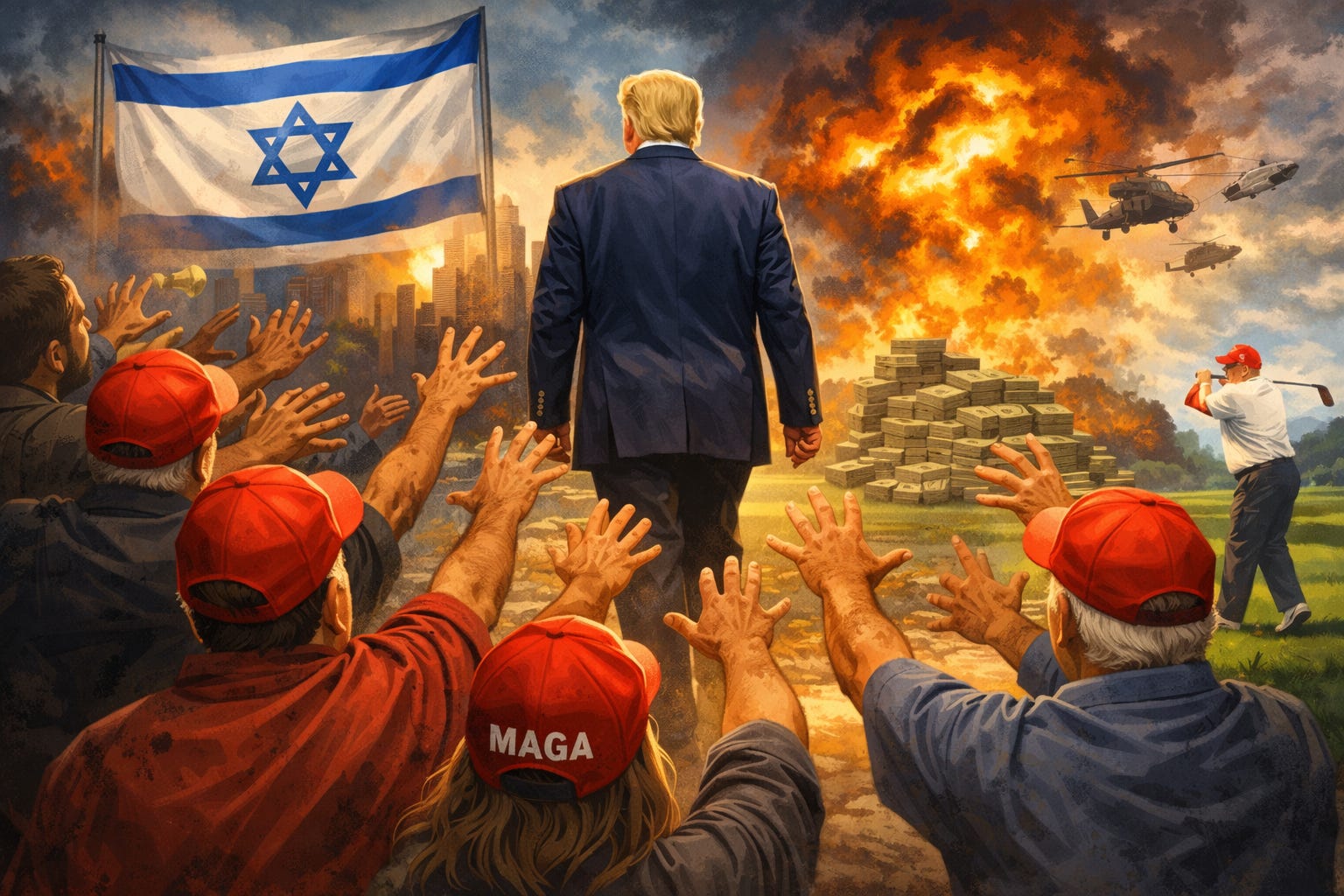
Trump’s Broken Promises: What Was Said, What Was Done, and What Still Has Not Happened
A presidency defined by partial fulfillment at home and a potentially historic break in foreign policy abroad.
Donald Trump ran for office the same way he always does: with big promises, hard edges, and a style built to make people feel a dramatic turnaround was right around the corner. He did not campaign like someone selling small adjustments or cautious compromise. He campaigned like someone promising to remake the country fast, forcefully, and unmistakably.
That is why the gap between the campaign and the governing matters so much. When the promises are that large, the results have to be measured the same way. Not by slogans, not by talking points, and not by the excitement of the moment, but by what actually happened after the election.
And when you go promise by promise, the picture becomes a lot less tidy than the campaign made it sound. Some things were done. Some were done in part. Some were narrowed down to something barely resembling the original pitch. Some remain stalled. And some, despite repeated claims, simply have not been delivered.
No New Wars
Trump promised no new wars, and that promise is especially important because it was one of the clearest parts of his foreign policy pitch. He ran as the president who would keep America out of new conflicts, avoid endless war, and bring some discipline back to U.S. foreign policy. But that promise has not held up. Iran is the clearest example of the gap between what was promised and what is happening now. Instead of stepping back from confrontation, the situation has become more dangerous, more unstable, and more confusing, with the United States sliding deeper into a foreign-policy mess that looks nothing like the restraint voters were told to expect. That is why this promise cannot be left out of any honest review: it was central to the campaign, and the reality has moved in the opposite direction.
Immigration and Deportations
Immigration was one of the centerpieces of Trump’s campaign, and it remains one of the clearest examples of the difference between political theater and practical governance. He promised the largest mass deportation program in American history. Not a crackdown. Not a tougher line. The largest in history.
What happened is more complicated. The Department of Homeland Security reported over 605,000 deportations in Trump’s first year back in office, and another 1.9 million people it says voluntarily self-deported. Border crossings dropped sharply. Those are real numbers, and they represent genuine enforcement activity. But the gap between what was promised and what was delivered is still wide.
Mass deportation is not just a slogan. It is a massive logistical operation that requires detention space, transport capacity, court processing, and cooperation from other countries. The system does not scale up overnight, and the courts have blocked several of the administration’s more aggressive moves along the way.
Trump also said the government would prioritize violent criminals. That sounds more focused and defensible than sweeping deportations of everyone without legal status, but it is also a narrowing of the original promise. Once you move from a mass-deportation pitch to a violent-criminals-first pitch, you are already acknowledging that the campaign version was bigger than what the government can carry out.
The other part of the immigration story involves birthright citizenship. Trump signed an executive order on his first day back in office declaring that children born to undocumented immigrants would no longer automatically receive citizenship. Federal judges blocked the order almost immediately, calling it a direct violation of the 14th Amendment. The Supreme Court took up the question and the justices across both sides of the ideological spectrum expressed serious skepticism about the administration’s legal argument. The order remains blocked as of this writing.
The “Remain in Mexico” policy, officially called the Migrant Protection Protocols, was reinstated. Title 42 authority was reasserted. The administration moved to end the parole programs that had allowed migrants from Cuba, Haiti, Nicaragua, and Venezuela to enter legally. These were real policy shifts. But the wall remains unfinished, the courts remain involved, and the biggest promise of all still falls short of the campaign’s rhetoric.
The Epstein Files
This one deserves its own category, because it is not just a broken promise. It is a broken promise that became an active cover-up, conducted by the same administration that made the promise, in apparent violation of a law that same administration signed.
Trump campaigned loudly on releasing the Jeffrey Epstein files. It fit perfectly into the broader drain-the-swamp narrative: powerful people had been protecting a child sex trafficker for decades, the government knew the names, and only Trump would have the nerve to expose them. His base loved it. His allies in right-wing media pushed it constantly. It was red meat with real moral weight behind it, because the core premise was true. Epstein did traffic children. Powerful people did protect him. The files do exist.
Here is what actually happened.
For months after taking office, the administration stalled. In February 2025, the White House staged a photo opportunity where they handed conservative influencers white binders labeled “Epstein Files Phase One” and told them this was just a down payment on full transparency. The people who received those binders looked at them and said publicly that the documents were old, already public, and essentially worthless. The stunt backfired immediately.
Then Congress stepped in. Thomas Massie and Ro Khanna, a Republican and a Democrat, built a bipartisan coalition and filed a discharge petition to force a vote on the Epstein Files Transparency Act without leadership support. The House passed the bill 427 to 1 in November 2025. The Senate approved it unanimously. Trump signed it into law on November 19, 2025, only expressing support for the bill the day before Congress passed it, after months of opposition.
The law gave the Attorney General 30 days to release all files. The deadline was December 19, 2025. The DOJ missed it. What it released on that date was described universally as a fraction of what was required, with hundreds of pages entirely blacked out. Bipartisan condemnation followed immediately.
The DOJ acknowledged that a total of 6 million pages might qualify as files required to be released. After a heavily criticized rollout in waves, including a release of roughly 3 million additional pages in January 2026, the department declared in late January that it had met its legal obligations. Khanna and Massie wrote to a federal judge overseeing the case that they had “urgent and grave concerns about DOJ’s failure to comply” with the law. The DOJ argued in response that Congress had no standing to take them to court over it.
It got worse. An NPR investigation found that the DOJ removed and withheld portions of the Epstein files that contained allegations involving Trump directly, including FBI documents describing abuse claims by two separate women. One woman alleged abuse by Trump around 1983 when she was approximately 13 years old. Another described being taken to Mar-a-Lago by Epstein to meet Trump. The FBI had collected and internally circulated these allegations. The DOJ’s initial release redacted or removed the relevant pages. After congressional pressure, some of those materials were eventually released.
Former Trump allies who had pushed hardest for the files went quiet. Pam Bondi, Dan Bongino, and others who had been loudest about getting to the bottom of the Epstein network became noticeably less interested once they were in a position to actually do something about it. The working theory among observers, including Elon Musk who raised it before walking it back, was simple: Trump’s own name was in the files, and the administration had no interest in a full release for that reason.
A December 2025 poll found that 55 percent of Americans disapproved of Trump’s handling of the Epstein investigation, while only 26 percent approved. Among Republicans, 74 percent said they supported releasing the files. The base that cheered the loudest for this promise is the same base most betrayed by what actually happened.
Trump promised to expose the powerful people who protected Jeffrey Epstein. Instead, his Justice Department missed a legal deadline, released heavily redacted documents in drips, withheld files containing allegations about Trump himself, and then declared the matter closed. Massie called it blatant non-compliance with the law. Khanna said it was protecting rich and powerful abusers. Both of them are right.
If you want one example that captures the full gap between what Trump promised and what he delivered, the Epstein files is it.
The Border Wall
The border wall was always one of Trump’s most symbolic promises. It stood for control, strength, and the idea that the federal government could put a visible barrier between chaos and order. Construction activity resumed after Trump returned to office, and the administration has pointed to miles of new or reinforced fencing. But the wall is still not finished, and the politics around it have not changed.
A wall that is not fully built is still a partial wall. A policy that depends on executive orders rather than permanent law is still a policy that the next president can reverse. That is why this promise has never fully arrived in the way supporters imagined. Trump can tighten enforcement, shift priorities, and create the sense of a harder line. But unless the physical infrastructure is completed and the underlying policy is locked in by statute, it remains a campaign promise in progress rather than a campaign promise kept.
No Tax on Tips
This was one of Trump’s most popular economic promises, and here he can actually claim a real win. The One Big Beautiful Bill Act, which Trump signed into law in July 2025, included a provision allowing workers to deduct up to $25,000 per year in qualified tipped wages through 2028. That is a meaningful benefit for restaurant workers, bartenders, hotel staff, and others who rely on tips as a significant part of their income.
The caveat is that it is temporary, lasting only through 2028, and it applies only under a certain income threshold. Critics also pointed out that the provision, depending on how it is applied, could allow higher-wage earners to reclassify some of their compensation as tip income, creating a backdoor benefit for people who were never the intended recipients. Still, for working people who actually live off tips, this was a real change. It counts as kept, with an asterisk.
No Tax on Overtime
The same legislation that addressed tips also delivered on Trump’s promise to exempt overtime wages from income taxes. Workers covered under the Fair Labor Standards Act can now deduct up to $12,500 per year in overtime compensation through 2028. Like the tips provision, it has an expiration date and income limits. But it is real, it is law, and it is one of the cleaner examples of a campaign promise that actually got done.
Extending the 2017 Tax Cuts
Trump’s 2017 tax overhaul was set to expire at the end of 2025, and he promised to extend it. The One Big Beautiful Bill Act extended the framework created under the Tax Cuts and Jobs Act, keeping the lower individual tax rates in place.
However, the messaging that “families are getting major tax relief” leaves out some important details about how the benefits are distributed. Many middle income families with one or two children often see relatively small changes. For example, estimates from tax policy analysts show that a typical middle class household earning around $75,000 to $90,000 might see a tax reduction in the range of roughly $500 to $1,200 per year depending on deductions and filing status. For many households that amounts to roughly 0.5 to 1.5 percent of income.
By contrast, some of the larger family oriented provisions scale with the number of children. A household with four or more children can receive several thousand dollars more in credits depending on eligibility and income phaseouts. That means the difference between a family with two children and a family with four or five children can be several thousand dollars annually.
Corporate provisions are also significant. The corporate tax rate that was cut from 35 percent to 21 percent under the Tax Cuts and Jobs Act remains in place, which represents a 14 percentage point reduction in the federal corporate rate. Supporters argue this encourages investment and job growth. Critics argue it represents one of the largest permanent benefits in the law.
Budget analysts estimate that extending these tax provisions could add several trillion dollars to the national debt over the next decade. Estimates commonly fall in the range of roughly $3 trillion to $4 trillion depending on growth assumptions and future policy changes.
So while the promise to extend the tax cuts was fulfilled, the size of the benefit varies widely. For many households it amounts to hundreds or about a thousand dollars per year, while larger families and corporations can see significantly larger financial gains.
Social Security Taxes
Trump promised to eliminate taxes on Social Security income for beneficiaries. The promise was popular because it spoke directly to retirees living on fixed incomes. What got delivered was narrower. The 2025 tax law created a significant tax break for people over 65, but it did not eliminate the tax entirely and it does not cover all Social Security recipients. PolitiFact rated this a compromise. The break also expires in 2028.
Trump separately pledged he would not cut Social Security benefits, and on that specific point he has been consistent. The One Big Beautiful Bill did not cut Social Security. Whether that remains true through the full term remains to be seen, but so far the commitment has held.
Tariffs and Trade
Trump was emphatic during the campaign that tariffs would be a centerpiece of his economic agenda. He proposed broad tariffs of 10 to 20 percent on foreign goods, with even higher rates floated in some speeches. He suggested at times that tariffs could eventually replace the income tax altogether, or at least dramatically reduce the burden on working Americans.
What happened in practice was more chaotic than the pitch. Trump did impose sweeping tariffs on imports from China and other trading partners, triggering market turmoil and a whipsaw of announcements, pauses, and partial rollbacks. The tariffs raised real revenue but also raised prices on imported goods, which hit consumers directly. The courts began pushing back on presidential tariff authority, and several of the most aggressive actions faced legal challenges.
The claim that tariffs would somehow replace income taxes has gone quiet because the math never worked. Tariffs shift costs. They do not eliminate them. The burden moved, not disappeared, and in many cases it moved onto American businesses and consumers.
Inflation and Prices
Trump promised on day one to end inflation and make America affordable again. He said it plainly and repeatedly, at rally after rally. The problem is that presidents do not control prices the way voters sometimes imagine. Inflation is driven by supply chains, energy costs, interest rates, global demand, and labor markets. It does not respond to executive orders.
PolitiFact found that prices for some items, including gasoline and select groceries, did drop during Trump’s first year back. But housing costs, electricity, medical care, and broad grocery prices remained higher than when he took office. The Consumer Price Index for December 2024 showed prices up 2.9 percent year over year. Inflation slowed from its Biden-era peak but did not reverse. The promise was to slash prices. The result was continued price levels that most Americans still feel as economic pressure.
No Tax on Social Security and Medicare Protection
Beyond the tax break discussed above, Trump made a broader commitment that he would never cut Medicare or Social Security. This was not just a promise, it was a line he repeated emphatically whenever opponents suggested his fiscal agenda would require entitlement cuts. The Republican platform stated it explicitly.
The One Big Beautiful Bill does not cut Social Security or Medicare directly. However, budget analysts point out that the law’s massive addition to the national debt will eventually create pressure to address those programs. Whether that constitutes keeping the spirit of the promise is a debate for a later reckoning. For now, the cuts have not happened, but the fiscal math will not stay quiet forever.
Eliminating the Department of Education
Trump promised to shut down the Department of Education and return control of education to the states. This was a clear, direct promise. He has not delivered it. The department still exists. It has been significantly cut, with spending reduced by tens of billions of dollars in 2025, and several grants and DEI-related programs were eliminated through DOGE-related actions. But abolishing a federal agency requires an act of Congress, and Congress has not done that.
What happened instead is a partial dismantling. The department’s budget shrank, its staff was reduced, and its focus shifted. But it is still standing. Calling this a kept promise would be a stretch. It is somewhere between in progress and stalled.
DOGE and Government Reform
Trump entered his second term promising to drain the swamp, clean up government, and slash wasteful spending. He formalized this through the Department of Government Efficiency, which he put Elon Musk in charge of. Musk came in wielding a chainsaw, literally and figuratively, and promised to cut at least $2 trillion annually from federal spending.
The final tally tells a complicated story. The federal civilian workforce did shrink significantly, dropping from about 3 million workers in January 2025 to roughly 2.74 million by November of that year. Musk targeted USAID, which was effectively dismantled and folded into the State Department. Grants, contracts, and leases were canceled across dozens of agencies.
But the spending number went the wrong direction. The federal government spent about 6 percent more in 2025 than it did in 2024. DOGE’s own advertised savings of $160 billion were disputed, with independent analysts putting the figure closer to $80 billion. When your target was $2 trillion and your result was maybe $80 billion, you did not hit your target. Musk himself revised his goal down from $2 trillion to $1 trillion to $150 billion across the year before departing in the spring.
The Cato Institute put it plainly: DOGE had no noticeable effect on the trajectory of government spending. What it did accomplish was the largest peacetime reduction in the federal workforce on record. Whether that is the same thing as fixing government depends on what you think government is for.
Ending the Ukraine-Russia War
Trump said he would end the war in Ukraine in 24 hours. He said it dozens of times. It was not a casual comment. It was a core campaign claim, and he repeated it so often that CNN compiled 53 separate instances of Trump promising to end the conflict within a day or before taking office.
He did not. The war is still going. Trump met with Putin in Alaska in August 2025. He met with Zelensky multiple times, including a now-infamous Oval Office confrontation in February 2025 that ended in an on-camera blowup. Delegations from both sides met in Geneva in February 2026 for U.S.-brokered talks but reached no resolution.
Putin has maintained maximalist demands. Zelensky has refused to cede Ukrainian territory still under Kyiv’s control. Trump has at various points blamed Zelensky for prolonging the conflict, pressured Ukraine to deal, and offered security guarantees that European allies view with deep skepticism. The war that was supposed to end in a day has now stretched past Trump’s one-year mark with no end in sight.
This is the clearest broken promise on the list. Not stalled. Not in progress. Broken. Trump told voters he could stop a war with a phone call. He could not.
NATO and Foreign Alliances
Trump campaigned on fundamentally reevaluating NATO’s purpose and conditioning American defense commitments on whether allies paid their fair share, defined as 2 percent of GDP on defense spending. He famously said he would “encourage” Russia to do whatever it wanted with NATO members who were “delinquent.”
In practice, his pressure on NATO allies to increase spending produced real results. European defense spending rose significantly, driven in part by Trump’s demands and in part by the ongoing war in Ukraine. NATO Secretary General Mark Rutte pushed members toward targets considerably above the 2 percent baseline.
But Trump did not pull the U.S. out of NATO, did not formally condition Article 5 commitments, and has assured individual allies like Poland of U.S. support. The posture was more aggressive than previous administrations, but the action stopped short of the campaign’s most alarming implications. This is somewhere between a partial delivery and a bluff that was never fully called.
The Middle East and Gaza
Trump boasted about brokering a fragile ceasefire deal in Gaza as one of his foreign policy wins. There was indeed a ceasefire agreement reached in early 2025, though its durability remained uncertain and the underlying conditions in Gaza did not change dramatically. Trump made clear early on that the U.S. would not fund the reconstruction of Gaza and had no intention of sending troops.
He also floated the idea of the U.S. “taking over” Gaza, which drew international condemnation and went nowhere. His broader Middle East policy involved withdrawing from the tone of previous administrations on Palestinian statehood while maintaining strong support for Israel. The ceasefire counts as something, but claiming it as a signature foreign policy achievement requires overlooking how fragile it was.
The Iron Dome for America
Trump promised to build a missile defense shield over the entire United States, which he called a great iron dome, made in America. This remains in the aspiration stage. There has been no legislation, no major procurement, and no concrete plan presented to Congress. The technology involved is extraordinarily complex and expensive, and no timeline has been established. File this one under “announced but not started.”
Transgender Issues and Social Policy
Trump made multiple promises related to gender and social policy, and here he moved faster and more decisively than almost anywhere else in his agenda.
On his first day back in office, he signed an executive order declaring the federal government recognizes only two sexes, male and female. He followed that with orders restricting transgender people from serving openly in the military. He signed an order cutting federal funding to hospitals and healthcare providers that perform gender-related care for minors. In February 2025, he signed the “No Men in Women’s Sports” executive order, directing federal agencies to interpret Title IX as prohibiting transgender athletes from competing in women’s categories.
Several of these orders faced immediate legal challenges. Federal judges blocked the gender-affirming care funding restrictions. The birthright citizenship order remains blocked. The transgender military ban survived a Supreme Court ruling allowing it to move forward. Courts across the country have been wrestling with the scope of these orders.
The overall picture is that Trump delivered on the cultural signaling of these promises faster than almost anything else. Whether the actual policy effects survive full legal scrutiny is still unresolved. But if you were a voter who wanted a president to push back aggressively on transgender-related policy, Trump did that.
Abortion and the Supreme Court
Trump repeatedly told supporters he was “proudly responsible” for overturning Roe v. Wade, which happened during his first term through his three Supreme Court appointments. During the 2024 campaign, he notably stepped back from proposing any new federal abortion restrictions, eventually saying he had “never even thought about” altering the Affordable Care Act and that abortion policy should be left to the states.
This was a significant narrowing of earlier commitments. Trump had previously called himself the most pro-life president ever. By the 2024 race, he was essentially saying the job was done with Roe’s reversal and the rest was up to state legislatures. That may have been a strategic retreat to avoid losing suburban votes, but it left many pro-life advocates unsatisfied. He kept the part about federal action by not taking any. Whether that counts as a promise kept depends on which promise you were listening to.
Taxes on Cars, Regulations, and Manufacturing
Trump promised to impose tariffs on foreign cars and roll back environmental regulations that he said were killing manufacturing. The One Big Beautiful Bill and various executive orders did eliminate a range of regulations. The EPA budget was targeted for cuts of over 50 percent in Trump’s proposed 2026 budget.
On manufacturing, Trump has pointed to factory announcements and claimed the U.S. is seeing record levels of new plant construction. The broader promise of a manufacturing renaissance has moved some, but not dramatically. Reshoring is a slow process. Companies decide where to build based on labor costs, infrastructure, supply chains, and market conditions. Executive pressure helps at the margins. It does not produce overnight industrial transformation.
Law and Order, Crime, and Police
Trump ran on a tough law and order platform, promising to support police, crack down on crime, and address what he described as the destruction of cities under Democratic leadership. He signed executive orders on police support, and the Justice Department under his administration scaled back the consent decrees and oversight agreements that the Biden administration had entered with several police departments.
Violent crime statistics had actually been declining before Trump returned to office, which complicated the campaign narrative somewhat. Whether the administration’s approach has maintained or extended that trend remains difficult to measure this early in the term.
Drug Cartels
Trump promised to wage war on drug cartels, including designating them as foreign terrorist organizations and using military force to address fentanyl trafficking. He did designate several cartels as terrorist organizations by executive order. He invoked the Alien Enemies Act to facilitate deportations of people the administration claimed were cartel members. The military posture along the border increased. But a declared “war” on cartels in the literal military sense did not happen, and fentanyl remains a significant public health crisis. This is somewhere between partial delivery and ongoing.
TikTok
Trump promised to save TikTok, which was facing a congressional ban over national security concerns about its Chinese parent company. A deal was structured in early 2025 involving U.S. investors, including Oracle’s Larry Ellison, taking a major stake in the platform’s operations. Trump claimed credit for the resolution.
The result was messier than the promise sounded. TikTok did not simply stay as it was. The ownership structure shifted, the political meaning of the arrangement became contested, and the national security concerns that drove the original legislation did not disappear. Trump can claim he addressed the issue. Whether voters got the simple outcome they imagined from “I will save TikTok” is a different question.
Energy, Drilling, and Dominance
Trump promised to make the United States the dominant energy producer in the world by far. He ordered the reopening of federal drilling permits, moved to reverse Biden’s ban on offshore oil and gas development, removed limits on natural gas exports, and broadly rolled back environmental regulations affecting the energy sector.
Energy production increased. The “drill, baby, drill” posture was real and it had real-world effects. But the energy market is driven by global prices, investment cycles, and infrastructure timelines, not executive orders alone. Trump can point to genuine movement here. Whether it rises to the level of “dominance” in any measurable geopolitical sense is harder to prove.
Healthcare
Trump has continued to say he is going to fix healthcare. During the 2024 campaign, he eventually abandoned the Affordable Care Act repeal that defined his first term’s legislative agenda, saying he had “never even thought about such a thing” after years of promising to repeal and replace it. He aligned himself with Robert F. Kennedy Jr. and the “Make America Healthy Again” posture, focusing on chronic disease, pharmaceutical industry reform, and processed food.
Kennedy was installed at the Department of Health and Human Services and made headlines for various initiatives targeting food dyes, ultraprocessed ingredients, and vaccine research transparency. Whether any of that translates into meaningful health outcomes for ordinary Americans remains an open question. The broader promise of fixing healthcare, the structural one involving costs, coverage, and access, remains exactly where it has been for decades: mostly rhetoric, very little resolution.
Housing
Trump promised some of the most aggressive housing reform plans in American history. He raised the idea of lenders offering 50-year mortgages. He suggested a national housing emergency declaration. The One Big Beautiful Bill expanded the low-income housing tax credit and increased State and Local Tax deductions.
Home sales continued to decline as prices remained elevated throughout 2025. Inventory levels increased modestly, roughly 20 percent in March 2025 compared to the prior year, but a housing shortage, particularly for middle-class buyers, persisted. The grand promise of making housing affordable again has not arrived in any tangible way that most Americans can feel.
Voter Integrity and Election Law
Trump promised to require proof of citizenship to vote in federal elections. House Republicans passed the SAVE America Act, which would alter federal voter registration requirements. The bill faces significant hurdles in the Senate. The promise is rated stalled.
Trump also made noise about nationalizing elections and at one point posted on Truth Social asking whether he should run for a fourth term. His press secretary clarified the fourth-term comment was a joke. Whether the election-law agenda produces lasting change will depend heavily on what survives congressional and judicial scrutiny.
Concealed Carry Reciprocity
Trump promised to pursue national concealed carry reciprocity, meaning a concealed carry permit from one state would be recognized in all states. House Republicans have introduced legislation along those lines, and Trump has supported the idea. But the bill faces a long path through the Senate and significant opposition. More than half of states already have some version of reciprocity agreements with other states, but a national standard is still not law. This is rated in progress.
Pardons for January 6 Defendants
Trump did follow through on this one. On his first day back in office, he granted roughly 1,500 full, complete, and unconditional pardons to defendants charged in connection with the January 6 Capitol attack. He had described those charged as “hostages” during the campaign and pledged in an interview after his election to pardon most of them “in the first hour.”
He was a few hours late, but he kept the promise. Supporters saw it as overdue justice. Critics saw it as a dangerous signal about political violence. The debate over what the pardons meant did not end with the signing. But the act itself was delivered.
Venezuela and Maduro
Trump scored one foreign policy success that did not appear on most campaign promise lists but landed as a significant claim in his 2026 State of the Union address. In an audacious military operation, the administration captured Venezuelan President Nicolas Maduro and his wife, transporting them to New York to face federal drug conspiracy charges. Trump claimed the operation as a major victory, and the arrest of a sitting head of state on U.S.-initiated charges is genuinely unprecedented in recent history.
The downstream effects on Venezuela’s political situation remained unclear. But as an action item, it happened.
Looking across all of these promises together, a pattern emerges that is more complicated than either side wants to admit.
Trump kept some things outright. He pardoned many of the January 6 defendants. He signed tax legislation that removed federal taxes on tips and overtime for many workers. He extended the 2017 tax cuts. He moved quickly on immigration enforcement and border crossings dropped significantly compared to previous years. Early enforcement actions increased arrests and removals, but the mass deportation operation that was described during the campaign has since slowed and in several areas been halted by court challenges, logistical limits, and political pushback from states and cities. He issued executive orders on transgender policy almost immediately after taking office.
He partially delivered on others. The deportation effort expanded but never reached the scale promised on the campaign trail. Pressure on NATO allies did produce increased defense commitments, but nothing close to the dramatic realignment that campaign rhetoric suggested. Federal workforce cuts associated with the Department of Government Efficiency reduced staffing levels but did little to slow overall federal spending. The energy agenda moved forward through approvals and regulatory changes but did not produce the “energy dominance” levels that were advertised.
Some promises were simply not fulfilled. The war in Ukraine was not ended in a day and it was not ended within a year. Prices across the economy did not fall in a sustained way. Healthcare was not replaced with a new system. The Department of Education still exists. The proposed nationwide missile defense shield remains largely conceptual. The southern border wall remains incomplete. Birthright citizenship remains unchanged. The national debt continues to grow rapidly.
But one issue now stands far above the others. The conflict involving Iran has moved beyond a typical campaign promise gap. Trump repeatedly campaigned on avoiding new wars and keeping the United States out of foreign conflicts. Escalation with Iran represents a direct break from that core promise. More than that, it carries consequences far beyond domestic policy debates.
A war involving Iran risks drawing in regional powers, destabilizing global energy markets, and pulling the United States into another prolonged Middle East conflict. The stakes are dramatically higher than a tax provision or a regulatory change. This is not an ordinary presidential miscalculation. The scale of potential consequences reaches from the stability of the United States economy to the risk of a much larger international conflict.
Critics also argue that the administration’s posture has increasingly prioritized the strategic interests of Israel over the long term interests of the United States, particularly as tensions escalate between Israel and Iran. Whether one agrees with that assessment or not, it is central to the current political debate.
Taken together, this presidency shows both little delivery and mostly failure. Few promises were carried out. Some were partially implemented. Others were abandoned or proved impossible to achieve. But the Iran question changes the weight of the discussion. When the issue shifts from domestic policy to the possibility of a major war, the gap between what was promised and what is happening becomes far more consequential.
It is easy for campaigns to promise decisive action and sweeping change. Governing always exposes limits. The difference now is that the most serious consequences are no longer about policy details. They are about the risk of conflict on a scale that could shape the future of the country and potentially the world.
References
USA Today, “Trump’s 20 core promises: What to know about his policy platforms.” usatoday
White House, “365 WINS IN 365 DAYS: President Trump’s Return Marks New Era of Success, Prosperity.” whitehouse
PBS NewsHour, “Trump says he’s kept all of his campaign promises. PolitiFact’s MAGA-Meter shows otherwise.” pbs
PolitiFact, “MAGA-Meter: Trump’s Second Term.” politifact
PolitiFact, “Trump says he’s kept all of his campaign promises. Our MAGA-Meter shows something different.” politifact
AP, “Trump offered a bountiful batch of campaign promises that come due on day 1.” ap
The Hill, “How Trump fared on key campaign promises in 2025.” thehill
Kiplinger, “Trump Tax Bill 2025: What Changed and How It Affects Your Taxes.” kiplinger
Times of Israel, “TikTok deal with pro-Israel Larry Ellison spurs exodus to Palestinian-founded app.” timesofisrael
CNBC, “Trump’s ‘big beautiful bill’ includes key tax changes for 2025.” cnbc
WBFF, “Crackdown in Minnesota ends but public backlash remains.” foxbaltimore
Spectrum News, “Which campaign promises did Trump fulfill in year one?” spectrumnews
NBC News, “Trump signs executive order banning trans women from women’s sports.” nbcnews
NPR, “Trump executive order seeks to ban transgender athletes from women’s sports.” npr
NPR, “The DOGE mindset is still central to the Trump administration’s agenda as 2025 ends.” npr
Yahoo Finance/CNN, “Elon Musk’s DOGE tally: The federal workforce is down while government spending is up.” yahoofinance
CBS News, “Despite Trump’s promised cuts, U.S. spent more than $200 billion more in first 100 days than last year.” cbsnews
CNN, “Fact check: It wasn’t ‘in jest.’ Here are 53 times Trump said he’d end Ukraine war within 24 hours or before taking office.” cnn
PBS NewsHour, “State of the Union offers Trump a chance to make the case for his foreign policy approach.” pbs
Wikipedia, “Donald Trump 2024 presidential campaign.” wikipedia
AllSides, “Tracking Trump’s Campaign Promises.” allsides
The American Presidency Project, “2024 Republican Party Platform.” presidency.ucsb.edu


