The Technate Blueprint That Wouldn’t Die: Technocracy, The Technate, and the Familiar Shape of American Ambition
How a 1930s movement to replace democracy with experts is echoing in today’s political and tech landscape
In the 1930s, a serious and well-organized movement decided that democracy had run its course. They called themselves Technocrats, and their argument was simple. The modern world had grown too complicated for politicians, too complex for ordinary voters, and too important to be left to the chaos of elections and public debate. What society needed, they said, was management by engineers and scientists. People who understood systems. People who could optimize. They drew up a map, a plan, and a vision for the entire continent. When you lay that map next to the headlines of 2025 and 2026, something deeply uncomfortable comes into focus.
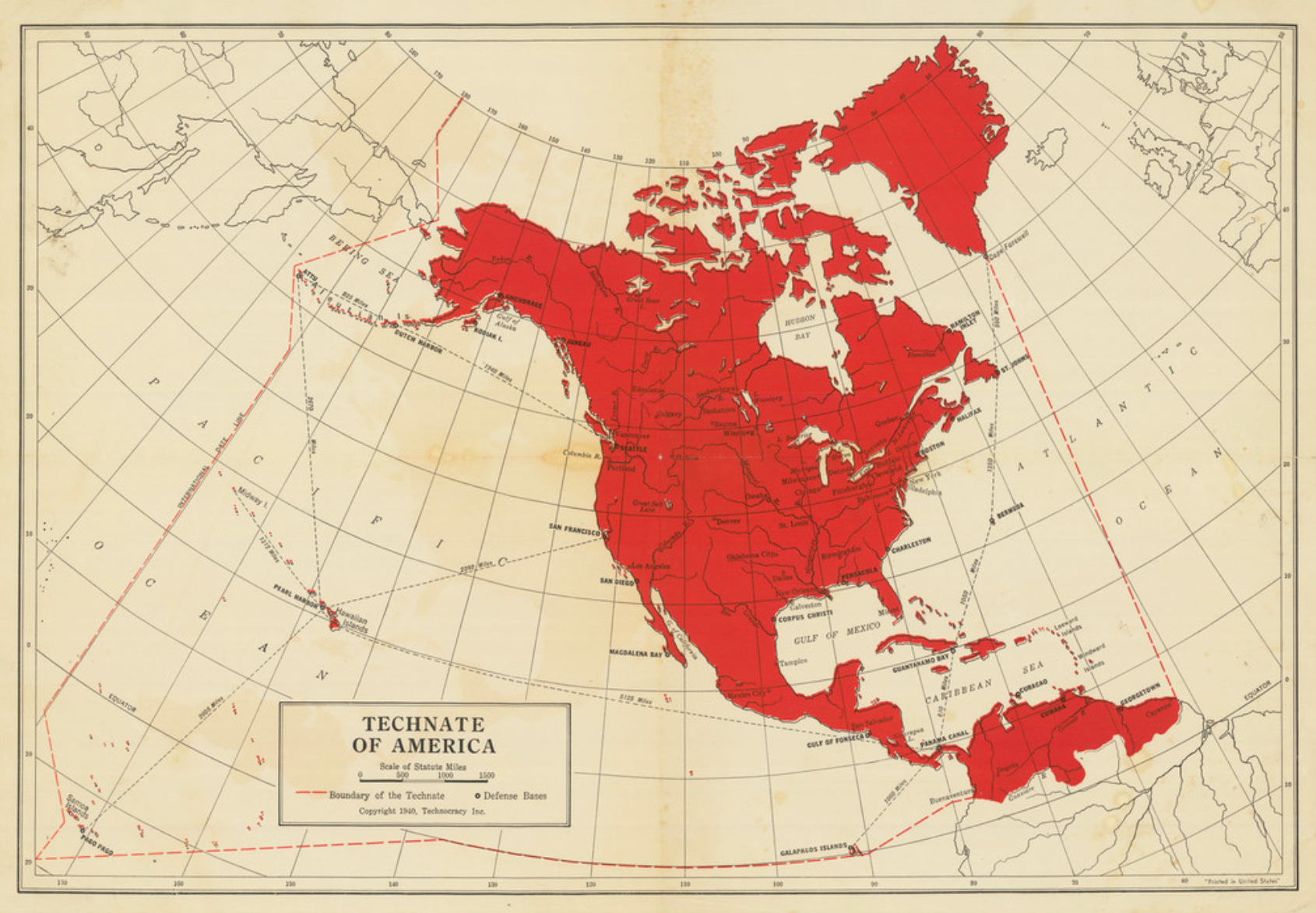
The plan was called the Technate. It was not a vague idea scribbled on a napkin. It came with detailed maps, organizational charts, and very specific geographic boundaries. The Technate would cover the United States, Canada, Greenland, Mexico, Central America, the Caribbean, and parts of northern South America. The thinking behind it was not political. It was industrial. These regions shared energy systems, natural resources, and geographic connections. Together, they formed what Technocrats called a self-sufficient production zone. National borders did not matter to them. Democratic governments were obstacles. The goal was to bring the entire landmass under one rationally managed system, replacing money with energy credits and replacing elected leaders with appointed experts who actually knew what they were doing.
Look at that map for a moment. Then open a newspaper from the past several months.
The Trump administration has made aggressive and repeated moves toward taking control of Greenland, framing it as a matter of national security and strategic need. Canada has been hit with annexation talk so consistent and pointed that Canadian officials have had to publicly defend their country’s sovereignty in ways they never thought they would need to. Mexico has faced the threat of direct military action, with American troops and surveillance assets positioned at the border and administration officials openly discussing operations inside Mexican territory. Panama and its canal have been named directly as targets for American reassertion of control. Cuba is back in American crosshairs. And in Venezuela, the United States helped push out Nicolas Maduro, removing a government in a country that sits, not by coincidence, right inside the southern boundary the Technocrats drew on their continental map nearly ninety years ago.
The Technate map and the current administration’s geographic ambitions do not just rhyme. They overlap with a precision that is hard to ignore.
The original Technocracy movement fed off crisis. The Great Depression had destroyed public faith in democratic capitalism. Banks failed, unemployment swallowed a generation, and politicians had no real answers. Into that vacuum stepped a group of engineers and social theorists who argued the whole system needed to be rebuilt from the top down, not through revolution, but through pure rationalization. Society would be run the way a factory runs. Inputs, outputs, efficiency, optimization. Regular people would receive energy credits based on production capacity instead of wages. There would be no room for feelings, ideology, or the slow grind of democratic debate. The experts would simply manage things the right way.
That ideology never actually died. It just found new people to carry it.
Today the people carrying that worldview are not wearing lab coats. They are running satellite networks and artificial intelligence companies. Elon Musk, arguably the most powerful unelected person in the current American government, is the grandson of Joshua Haldeman, one of Technocracy’s most passionate organizers in Canada. Haldeman became a leading promoter of the movement in Saskatchewan during the 1930s before the Canadian government banned Technocracy in 1940 and had him arrested by the Royal Canadian Mounted Police under wartime emergency laws. The government saw the movement as a real threat to democratic stability. Haldeman eventually turned against it, calling Technocracy a kind of scientific Frankenstein that had lost all human proportion. His grandson does not appear to share that change of heart.
Musk now leads the Department of Government Efficiency, a body with no Congressional authorization, no democratic mandate, and no public accountability. He controls the most advanced satellite internet network on earth through Starlink. His artificial intelligence company is among the most powerful in the world. His data and surveillance reach, across all of his companies combined, rivals that of mid-sized nation-states. He has direct access to federal payment systems, personnel records, and agency operations across the United States government. And he was not elected to any of it.
Neither was Peter Thiel. The PayPal and Palantir co-founder built a data surveillance company that now runs through law enforcement, immigration enforcement, and intelligence agencies across the country. Neither were the many Silicon Valley executives and venture capitalists who have planted themselves in federal advisory roles, moving freely between private tech empires and public policy with no clear line separating the two.
The Technocrats of the 1930s wanted to swap democratic control for expert management. They wanted efficiency metrics instead of policy debates and technical authority instead of elected representatives. What is being built right now is not a perfect copy of that vision, but the bones of it are easy to recognize. Decisions that touch millions of lives are being made by people voters never approved. Government functions are being reorganized, gutted, or handed to private companies at a speed that skips past any real legislative oversight. Artificial intelligence is being used to manage benefits, evaluate citizens, and direct enforcement actions. The surveillance system being assembled today, through Palantir, through federal data merging, through Starlink, through the devices in everyone’s pockets, would have stunned the original Technocrats.
The geographic ambitions of the current administration complete the picture. The Technate needed a specific landmass to work as a unified production and energy system. That landmass required Greenland’s Arctic position, Canada’s resources, Mexico’s labor and energy supply, Central America’s transit routes, Caribbean shipping lanes, and South American resource extraction. The movement’s planners were not being poetic about those boundaries. They were being practical. Those regions together made up what they believed was the minimum territory needed for a truly self-sufficient system.
The current administration is pursuing control or serious influence over every single one of those same regions. The language is different. They say national security and strategic interest rather than energy accounting. But the destinations are strikingly similar. Greenland for Arctic access and rare earth minerals. Canada for its energy, water, and northern geography. Mexico for its border, its labor, and its oil. Panama for its canal. Venezuela, now without Maduro, for its oil reserves, which are the largest proven reserves on the planet. Cuba, again, as a strategic anchor in the Caribbean.
This is not a conspiracy theory. Conspiracy theories need hidden evidence. None of this is hidden. The Technate map is sitting in libraries and public archives. The current administration states its ambitions openly, sometimes eagerly. The tech executives who are shaping government policy have never been shy about their feelings on democratic efficiency. Peter Thiel has written plainly that he believes freedom and democracy cannot coexist. Musk has said similar things about the limits of popular government. The ideology is not being concealed. What has been missing is someone pointing at both things at the same time and noting how closely they match.
The original Technocracy movement collapsed partly because it was too honest. It said directly that it wanted to end democracy and replace it with expert rule. That honesty made it easy to fight and eventually easy to ban. The current version has learned from that mistake. It does not announce itself as anti-democratic. It calls itself efficient. It does not say it wants to end elections. It says it wants to drain the swamp. It does not present itself as a plan to hand power from the public to a small technical elite. It says it wants to give power back to the people, while at the same time concentrating real decision-making in the hands of a few unelected billionaires who share the same beliefs about why democratic government fails.
The question the Technocrats asked in the 1930s has not gone away. It has just been repackaged. Who should actually run a complex modern society? Should it be regular people making imperfect decisions through democratic processes? Or should it be the people who, by their own account, actually understand how the systems work?
Joshua Haldeman called his movement a Frankenstein. He saw where the logic led and walked away from it. His grandson is now standing at the controls of a version of that same experiment that is more powerful than anything the original Technocrats could have dreamed. The map they drew still exists. The territory it describes is being systematically pulled into alignment. And the same core argument, that democracy is too slow, that experts should decide, that the system needs to be managed rather than governed, is being made again, this time with better technology, far more money, and much less transparency than the original movement ever had.
Whether that makes today more dangerous or simply more sophisticated is a question worth sitting with for a while.
Sources:
https://www.cbc.ca/newsinteractives/features/joshua-haldeman-elon-musk-saskatchewan-tech-utopian-conspiracist
https://newsinteractives.cbc.ca/longform/technocracy-incorporated-elon-musk
https://bostonraremaps.com/inventory/technocracy-inc-technate-of-america-1940/
https://www.thetedkarchive.com/library/sam-maciag-geoff-leo-the-saskatchewan-roots-of-elon-musk-s-conspiracist-grandpa
https://thefulcrum.us/governance-legislation/doge-elon-musk-project-2025
https://www.npr.org/2024/12/04/nx-s1-5205354/musk-ramaswamy-doge-congress
https://www.usatoday.com/story/news/politics/2025/05/28/elon-musk-president-donald-trump/83901549007/
https://www.gfmreview.com/technology/elon-musk-tops-us-political-donor-list-with-270m-for-team-trump
https://www.imf.org/-/media/files/publications/wp/2024/english/wpiea2024226-print-pdf.pdf
https://www.canadashistory.ca/explore/politics-law/the-last-utopians
https://en.wikipedia.org/wiki/Technocracy_movement
https://en.wikipedia.org/wiki/Joshua_N._Haldeman


