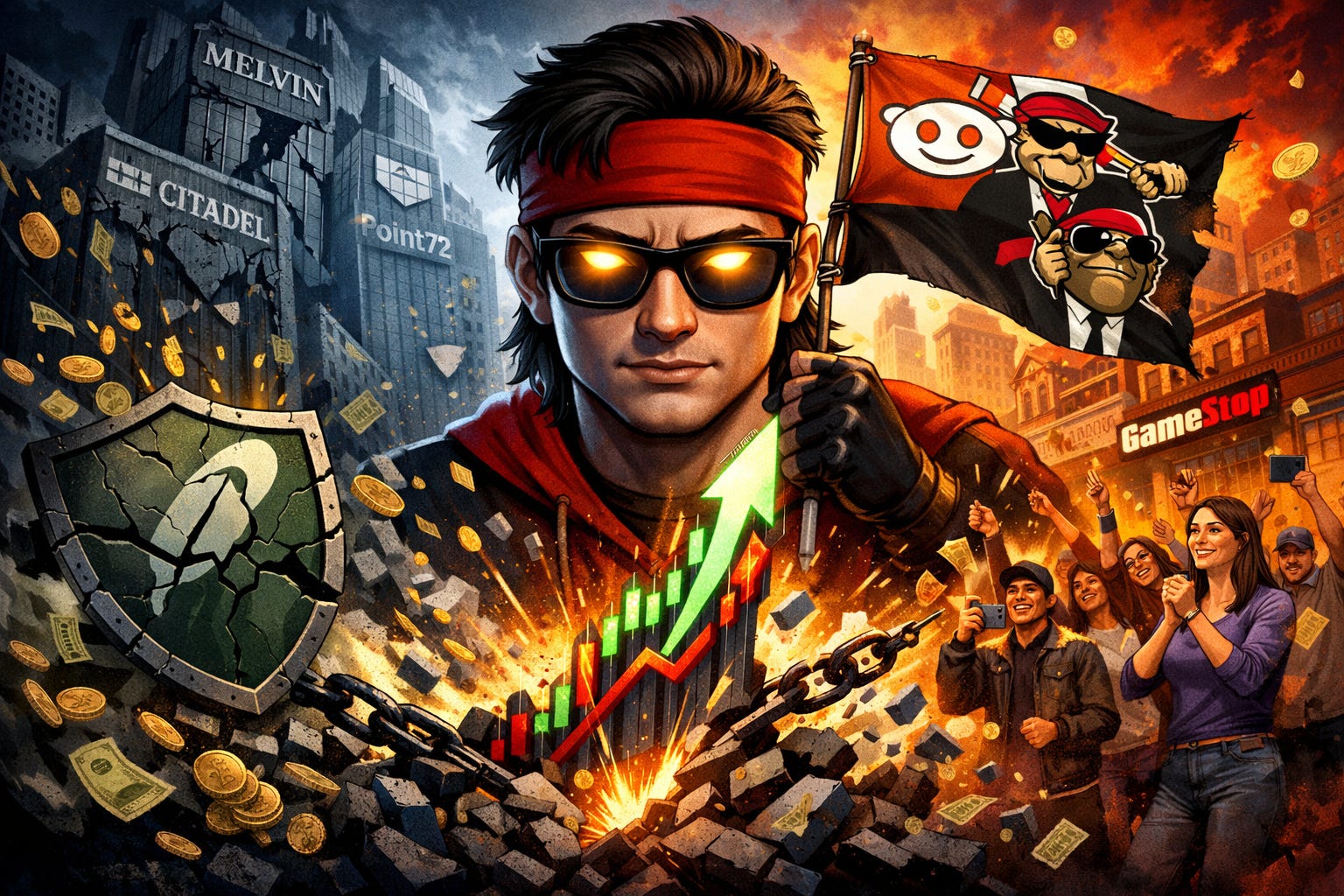
The Roaring Kitty and the Wall Street Rebellion:
How Retail Investors Challenged Financial Giants
In early 2021, the financial world witnessed an unprecedented event that pitted individual retail investors against powerful hedge funds, shaking the very foundations of Wall Street. At the heart of this saga was GameStop, a struggling brick-and-mortar video game retailer, whose stock became the battleground for a monumental short squeeze. This extraordinary episode, fueled by online communities like Reddit’s WallStreetBets and spearheaded by an enigmatic figure known as ‘Roaring Kitty,’ exposed vulnerabilities in the financial system, ignited debates about market manipulation, and highlighted the growing influence of crowdsourced investing.
This article delves into the intricate details of the GameStop phenomenon, exploring the motivations and strategies of the retail investors, the aggressive short-selling tactics employed by hedge funds, the controversial trading halts imposed by platforms like Robinhood, and the subsequent political scrutiny. We will examine the key players involved, their actions, and the lasting impact of this financial rebellion on the participants and the broader market landscape.
The Catalyst: Roaring Kitty and WallStreetBets
The narrative of the GameStop short squeeze is inextricably linked to Keith Gill, a financial analyst from Massachusetts who operated under the online monikers “Roaring Kitty” on YouTube and “DeepFuckingValue” (DFV) on Reddit. Gill, a father and certified financial analyst, began investing in GameStop (GME) in 2019, long before it became a household name. His investment thesis was rooted in a belief that GameStop was undervalued, with its stock price failing to reflect potential improvements in its business model and a high short interest that could trigger a short squeeze .
Gill meticulously documented his investment journey and analysis on YouTube and Reddit, sharing his strategies and highlighting what he saw as a significant disconnect between the company’s fundamentals and its market valuation. He believed that the negative sentiment surrounding GameStop was out of balance with its book value and fundamental improvements . His detailed explanations and conviction resonated deeply with the WallStreetBets (WSB) community, a subreddit known for its aggressive, often speculative, trading strategies and irreverent humor. WSB members, a diverse group of retail investors, found common ground in challenging institutional investors and hedge funds .
Gill’s consistent bullish stance on GME, coupled with his transparent approach, cultivated a loyal following. His analyses, often presented in live streams, became a focal point for the WSB community, transforming his individual investment into a collective movement. The subreddit became a hub for discussions, memes, and coordinated buying efforts, all aimed at driving up the price of GME and inflicting losses on the hedge funds that had heavily shorted the stock . This crowdsourced enthusiasm and shared conviction laid the groundwork for the unprecedented market event that was about to unfold.
The Short Squeeze Unleashed: Hedge Funds Under Siege
The GameStop saga was fundamentally a short squeeze, a market phenomenon where a stock’s price surges, forcing short sellers to buy back shares to limit their losses, which in turn further drives up the price. This cycle creates a cascading effect, inflicting significant financial pain on those who bet against the stock. The conditions for such a squeeze were ripe in GameStop, with an extraordinarily high short interest; at one point, approximately 140 percent of GameStop’s public float had been sold short . This meant that more shares had been sold short than actually existed, a situation that can arise from practices like naked shorting, where traders sell shares they haven’t borrowed or located, though the extent of naked shorting in GME remains a subject of debate .
Several prominent hedge funds had taken substantial short positions against GameStop, anticipating its decline. Among the most notable were Melvin Capital and Citron Research. These firms believed that GameStop’s business model was obsolete, and its stock was destined to fall. However, as retail investors, galvanized by Roaring Kitty’s analysis and the WallStreetBets community, began aggressively buying GME shares, the stock price started to climb rapidly. This upward trajectory put immense pressure on the short sellers.
Melvin Capital, led by Gabe Plotkin, was particularly exposed. As the price of GME soared, Melvin Capital faced billions of dollars in mark-to-market losses. On January 27, 2021, Melvin Capital announced it had closed out its short position in GameStop after taking a massive loss . The hedge fund reportedly lost more than a billion dollars a day at the height of the squeeze . To stave off further collapse, Melvin Capital received a $2.75 billion bailout from Citadel and Point72 Asset Management, hedge funds run by Ken Griffin and Steve Cohen, respectively . Citron Research, founded by Andrew Left, also suffered significant losses and eventually ceased publishing short-selling research .
The rapid ascent of GameStop’s stock price, driven by coordinated retail buying, demonstrated the collective power of individual investors. This collective action not only challenged the traditional dominance of institutional investors but also highlighted the inherent risks of heavily shorted stocks and the potential for market dynamics to be dramatically altered by a decentralized, online community.
The Trading Halt and Political Scrutiny: A Question of Fairness
As the GameStop stock price continued its meteoric rise, fueled by retail investor demand, a pivotal and controversial event occurred on January 28, 2021: several online brokerage platforms, most notably Robinhood, restricted trading in GameStop and other “meme stocks.” Users were suddenly prevented from buying shares, only allowed to sell, effectively halting the upward momentum. This decision sparked widespread outrage among retail investors and drew immediate criticism from across the political spectrum .
Robinhood, a platform that prides itself on democratizing finance, cited unprecedented market volatility and increased collateral requirements from clearinghouses as the reason for the trading restrictions . The National Securities Clearing Corporation (NSCC) had demanded billions of dollars in additional collateral from brokerages to cover the increased risk associated with the volatile trading. Robinhood, along with other brokers, faced a liquidity crunch, leading to the decision to restrict trading .
However, many saw this as a deliberate act to protect hedge funds from further losses, arguing that the system was rigged against the small investor. The close ties between Robinhood and large financial institutions, particularly Citadel Securities, a major market maker that processes a significant portion of Robinhood’s trades through payment for order flow (PFOF), further fueled suspicions of a conflict of interest . Citadel Securities had also provided capital to Melvin Capital, one of the hedge funds heavily shorted on GME, intensifying concerns about market manipulation.
The trading halt quickly escalated into a political issue, with calls for investigations and hearings. Congresswoman Maxine Waters (D-CA), Chairwoman of the House Financial Services Committee, announced a series of hearings to examine the events, stating that the meme stock market frenzy raised important questions about the fairness of financial markets and the treatment of retail investors . Other politicians, including Alexandria Ocasio-Cortez (D-NY) and Senator Ted Cruz (R-TX), also voiced their concerns, criticizing Robinhood’s actions and calling for transparency .
The congressional hearings featured testimony from key figures, including Robinhood CEO Vlad Tenev, Citadel CEO Ken Griffin, Melvin Capital CEO Gabriel Plotkin, Reddit Co-Founder Steven Huffman, and Keith Gill himself . While the hearings aimed to uncover the truth, they also highlighted the complex interplay between financial markets, technology, and political influence. The investigation by the House Financial Services Committee identified “troubling business practices, inadequate risk management, and a culture that prioritized rapid growth above stability” at Robinhood .
Adding another layer of controversy, it was revealed that Janet Yellen, who became Treasury Secretary shortly before the GameStop saga, had received substantial speaking fees from financial institutions, including Citadel, raising questions about potential conflicts of interest in any government response to the crisis . The events surrounding the trading halt underscored the deep-seated power imbalances in the financial system and ignited a broader conversation about market structure, regulation, and the influence of lobbying by powerful financial entities.
The Aftermath: Winners, Losers, and Lingering Questions
The GameStop short squeeze left a lasting impact on all involved, creating clear winners and losers, and prompting ongoing discussions about market reform.
Hedge Funds:
For Melvin Capital, the consequences were severe. After suffering catastrophic losses during the short squeeze, the hedge fund attempted to recover but ultimately failed. In May 2022, Gabe Plotkin announced that Melvin Capital would be winding down its funds and returning cash to investors, unable to fully recover from the billions lost in the GameStop saga . This marked a significant victory for the retail investors who had targeted the firm.
Other hedge funds, like Citron Research, also faced substantial losses and a damaged reputation. Andrew Left, the founder, announced that Citron would largely discontinue its short-selling research, shifting its focus to long-only opportunities . Citadel and Point72 Asset Management, while providing a bailout to Melvin Capital, also faced scrutiny for their roles and connections to Robinhood. Despite the controversy, Citadel Securities, a major market maker, continued to be a dominant force in the financial markets.
Keith Gill (Roaring Kitty):
Keith Gill emerged from the GameStop saga as a folk hero to many retail investors. His initial investment of $53,000 in GameStop reportedly grew to a peak of nearly $50 million by January 2021 . Despite facing a class-action lawsuit alleging securities fraud and market manipulation, which he denied, Gill maintained a relatively low profile for a period . However, he re-emerged in 2024, once again posting on social media and influencing the price of GME. As of June 2024, his net worth was estimated to be over $289 million, primarily from his GameStop holdings . His story became a testament to the potential for individual investors to challenge established financial powers.
Politicians and Regulators:
The GameStop event spurred significant political attention and calls for regulatory reform. The House Financial Services Committee, under Chairwoman Maxine Waters, conducted a thorough investigation, culminating in a staff report released in June 2022. The report highlighted “troubling business practices, inadequate risk management, and the need for regulatory and legislative reform” within the market . It specifically criticized Robinhood for prioritizing growth over stability and identified deficiencies in the market regulatory structure. The committee recommended policy changes to better understand retail traders, enhance supervision of “superbrokers,” and strengthen capital and liquidity requirements .
While the hearings brought transparency to some aspects of the market, concrete legislative changes have been slower to materialize. The debate continues regarding payment for order flow (PFOF), the role of clearinghouses, and the overall fairness of market structures. The involvement of figures like Janet Yellen, who had received speaking fees from firms like Citadel, also raised ethical questions about potential conflicts of interest in government oversight . The GameStop saga served as a stark reminder of the complex relationship between finance, politics, and the public interest, and the ongoing need for robust regulatory frameworks to protect all market participants.
References
[1] “Keith Gill - Wikipedia.” Wikipedia,
[2] “The Kitten Roars Again. The epic story of how Keith Gill went…” Cryptomaton,
[3] “Go read this profile of the trader whose huge bet on GameStop ...” The Verge,
[4] “GameStop EXPLAINED The Roaring Kitty Thesis 2020-2024.” YouTube,
[5] “Everything you need to know about WallStreetBets.” Ephemera Journal,
[6] “DFV Speaks: Keith Gill Drove the GameStop Reddit Mania. He ...” Reddit,
[7] “GameStop short squeeze.” Wikipedia,
[8] “Short Sellers Still Love to Hate GameStop.” Institutional Investor,
[9] “Naked Short Selling Explained: Process, Impacts, and ...” Investopedia,
[10] “The GameStop Episode: What Happened and What Does It ...” Cato Journal,
[11] “Melvin Capital, hedge fund targeted by Reddit board ...” CNBC,
[12] “Short Sellers Lose $5.05 Billion in Bet Against GameStop.” Investopedia,
[13] “Melvin Capital.” Wikipedia,
[14] “GameStop Short-Seller Melvin Capital Gets $2.8 Bailout From ...” Business Insider,
[15] “Citadel, Point72 Back Melvin With $2.75 Billion After Losses.” Bloomberg,
[16] “Citron Research’s Left shorts GameStop more than 3 years ...” Reuters,
[17] “Robinhood restricts trading in GameStop, other names ...” CNBC,
[18] “How Robinhood’s GameStop Trading Halt Reveals the ...” Fordham Law Review,
[19] “Robinhood, Reddit, and GameStop: What Happened and ...” Santa Clara University,
[20] “Market Manipulation and Its Band of (Not So ) Merry Men.” Ohio Bar,
[21] “Regulators Consider Payment for Order Flow and the ...” Carlton Fields,
[22] “The GameStop Episode: What Happened and What Does It ...” Cato Journal,
[23] “Robinhood, Citadel partnership likely to draw scrutiny after ...” The Washington Post,
[24] “Robinhood Took Fire From Congress - The New York Times.” The New York Times,
[26] “GameStop: Cruz, Ocasio-Cortez blast Robinhood over ...” CNBC,
[27] “Congress plans hearings after GameStop stock frenzy and ...” CBS News,
[28] “GameStop Hearing Live Updates: Keith Gill and CEOs of Robinhood ...” The Wall Street Journal,
[30] “Yellen received $800G from hedge fund in Gamestop controversy.” Fox News,
[31] “Janet Yellen got $810,000 to give speeches to Citadel, a key firm in ...” Slate,
[32] “Melvin Capital, Hedge Fund That Shorted GameStop, Is ...” The New York Times,
[33] “Gabe Plotkin on Why He’s Closing $7.5 Billion Melvin Capital.” Business Insider,
[34] “Plotkin’s Melvin Capital to liquidate funds after losses.” Fortune,
[36] “YouTube, Reddit User ‘Roaring Kitty’ Gets Sued for Securities Fraud ...” Gizmodo,
[37] “Roaring Kitty Net Worth: How Much Is Keith Gill Worth?” EBC,
[38] “Gamestop Roaring Kitty Net Worth in 2025.” Ultima Markets,
[39] “How Roaring Kitty’s wealth went from $53000 to nearly ...” CNBC,


