The Job Market Is Fake. And If You’re a Business That Posts Ghost Jobs, You Have a Legal Problem.
You’ve been applying for months. Tailoring the resume. Writing the cover letter. Hitting submit. And hearing nothing. Not even a rejection.
You start thinking something is wrong with you.
There isn’t. Many of those jobs aren’t real.
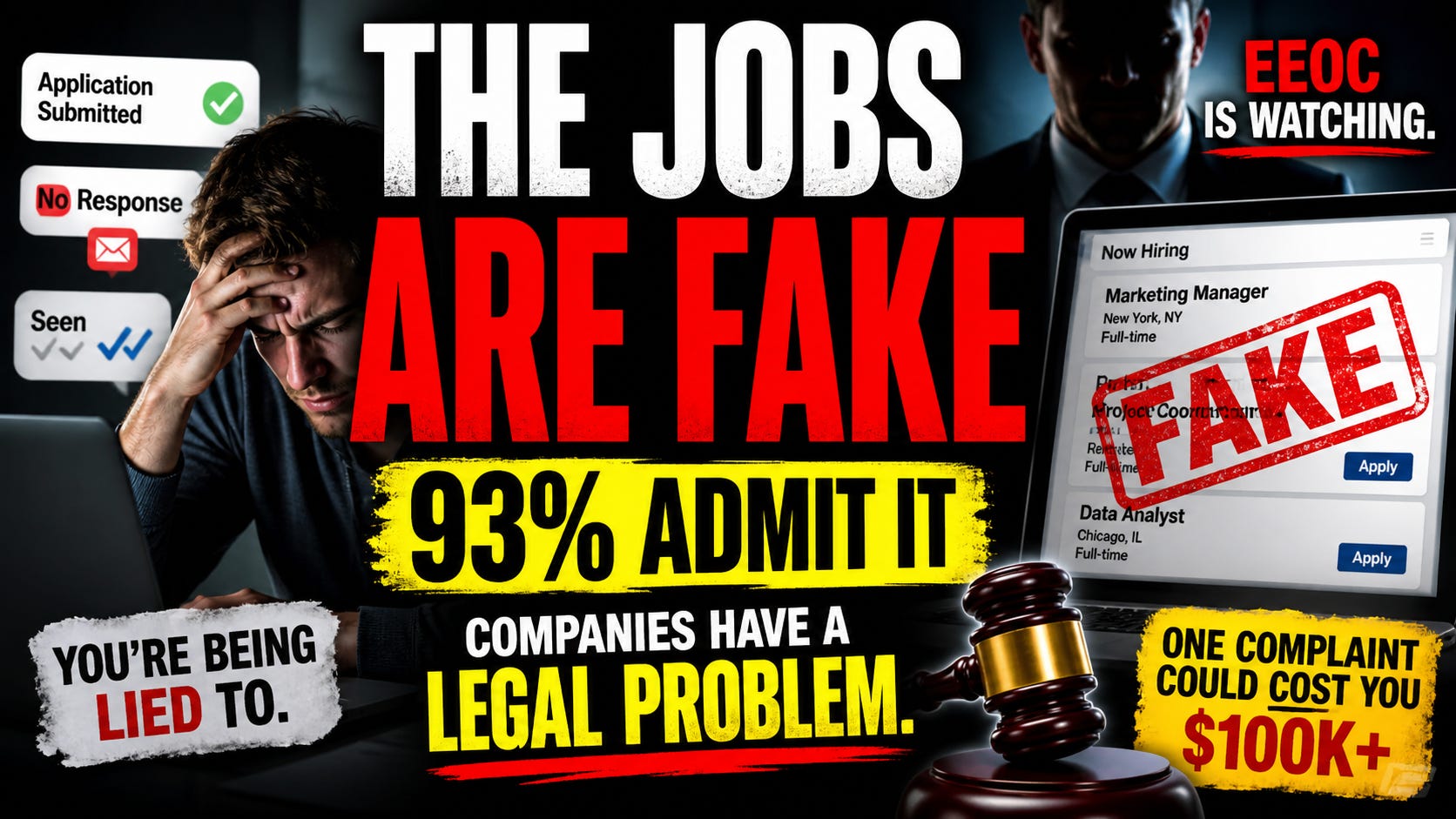
This isn’t a fringe theory. It’s documented across multiple studies in 2025. A LiveCareer survey of 918 HR professionals found that 45% admit they “regularly” post ghost jobs, listings with no real intent to hire. Another 48% said they do it “occasionally.” Combined, 93% of HR professionals engage in the practice. Only 2% said they never do it.
A Greenhouse study found that between 18% and 22% of all online job postings are ghost jobs. That’s roughly one in five listings. A separate analysis of LinkedIn data found that 27.4% of all active U.S. postings are likely ghost jobs, with no intention to hire.
This isn’t just annoying. For some of these companies, it’s a federal legal problem. And most of them have no idea how exposed they are.
What People Are Actually Going Through
Before we get to the law, let’s talk about what this looks like in real life. Because it’s not abstract. It’s not a statistic. It’s people.
There are people right now living in their cars. Not because they’re lazy. Not because they made bad choices. Because they have applied to hundreds of jobs and heard nothing back. There are entire threads on social media about how to survive the summer heat inside a vehicle. People are posting tutorials on how to keep from dying of heat exhaustion while sleeping in a parking lot. These are working-age adults with resumes and skills and genuine desperation, and they are being strung along by a system that is manufacturing the appearance of opportunity while delivering nothing.
People are crying in their cars. On camera. Posting it publicly because they have nothing left to lose and nowhere else to turn. Gas prices are bleeding them dry because of a war nobody voted for. Groceries are out of reach. Rent was already gone. And while all of that is happening, billion dollar companies are posting jobs that don’t exist, making people believe there might be a way out, letting them spend their last hours of hope and energy on applications that were always going to lead nowhere.
That is not a business practice. That is abuse.
Here’s a story that circulated online that says everything you need to know about what’s really happening. A job seeker applied to multiple positions and received zero responses. No callbacks. No rejections. Nothing. He changed one thing. His name. He submitted the same resume, same qualifications, same experience, but swapped his name for one that sounded Indian. The responses started coming. Multiple callbacks. The theory is that certain companies are specifically targeting candidates who appear eligible for H-1B visa status because those workers can be paid less, controlled more, and are far less likely to file complaints.
That is not a theory the EEOC takes lightly. The EEOC has already taken enforcement action against a company called DHI Group for permitting job listings that explicitly excluded U.S. workers based on national origin, finding reasonable cause that this violated Title VII. Preferring foreign visa holders over American applicants is textbook national origin discrimination under federal law. It is illegal. And it is happening right now at scale.
Here’s Where the Law Comes In
Ghost jobs are generally legal right now. But the moment a fake listing overlaps with a protected class, the company has crossed a line.
Read that carefully. It doesn’t just cover active discrimination. It covers practices that deprive people of opportunity. If a company posts a job that was never going to be filled, and a protected-class applicant spends weeks pursuing it, investing time and resources into a process that was a fiction from the start, that company has a potential exposure problem. The EEOC doesn’t require intent. It requires impact.
There’s also the Age Discrimination in Employment Act. It protects individuals who are 40 years of age or older from employment discrimination. If a company is using ghost jobs to build a resume pipeline while AI screening tools quietly filter out older workers, the EEOC wants to know about it. And companies are doing exactly this.
The door is open. And it’s going to get pushed wider.
Kentucky introduced legislation in January 2025 requiring employers to disclose whether a job posting is for an existing vacancy, with civil penalties for violations. California passed similar legislation in March 2025. A federal bill called the Truth in Job Advertising and Accountability Act has been introduced. The legal walls are closing.
Now Let’s Talk About the Insurance Problem
I sell Employment Practices Liability Insurance. EPLI. And I’m going to be direct about something I’ve watched happen for years.
Companies skip this coverage because they think it’s too expensive. They don’t think it’ll happen to them. They’ve never been sued. They assume their HR department is clean enough.
In the last two decades, the frequency of EPLI lawsuits has risen 400%. Four hundred percent. That’s not a trend. That’s a complete collapse of the assumption that you’re fine.
You’re at risk of an employment claim from the moment you interview a prospective employee. If you choose not to hire someone, that individual could allege discrimination. Now imagine you posted a job you were never going to fill, walked a real human being through a real interview process, took their time, raised their hopes, and then went silent. That’s not a hypothetical. That’s standard operating procedure for nearly half of American companies right now.
If your company posts ghost jobs and you don’t have EPLI, you are one complaint away from a five or six figure legal bill. Maybe more. And you will have no coverage to fall back on.
I spent years trying to sell this coverage politely. Presenting the facts. Making the case. Getting told it costs too much.
I’m done being polite about it.
And to the HR professionals personally posting these fake listings: you are not shielded by your employer. You are the one clicking publish. You are the one who knows the job isn’t real. As states move toward civil penalties and federal enforcement expands, the individuals responsible for deceptive postings are going to find themselves named alongside the companies they work for. That is not speculation. That is the direction the law is moving. Own it now or own it in a courtroom later.
This Is a Call to Organize
Since the beginning of 2024, job openings have outnumbered actual hires by more than 2.2 million per month, according to Bureau of Labor Statistics data. That gap is not economic friction. A significant portion of it is constructed fiction designed to fool investors, collect data, and manipulate the labor market statistics that the Federal Reserve uses to set interest rates that affect every person in this country.
People are living in their cars. People are going without. People are breaking down on camera. And while that is happening, these companies are posting fake jobs and calling it a hiring strategy.
That ends when enough people decide it ends.
If you have been chasing ghost jobs and you belong to a protected class under federal law, you have the right to file an EEOC charge. It costs nothing to file. You do not need a lawyer to start the process. The EEOC investigates. Companies get named. Records get subpoenaed. Reputations get damaged. And the more people who file, the harder it becomes for anyone to look away.
If you need help understanding how to file a complaint with the EEOC, leave a comment below with your story. Tell me what happened. Tell me how many jobs you applied to. Tell me what company strung you along. Tell me if you suspect discrimination was a factor. I will help point you in the right direction. I will help you understand what your rights are and what the process looks like.
You are not alone in this. There are millions of people in exactly your situation and most of them think they failed when the system failed them.
The jobs aren’t real. The companies that post them are real. The laws protecting you are real. And the people who are breaking those laws are going to start finding out that accountability is real too.
Subscribe. Share this. Leave your story in the comments. Let’s build something.


