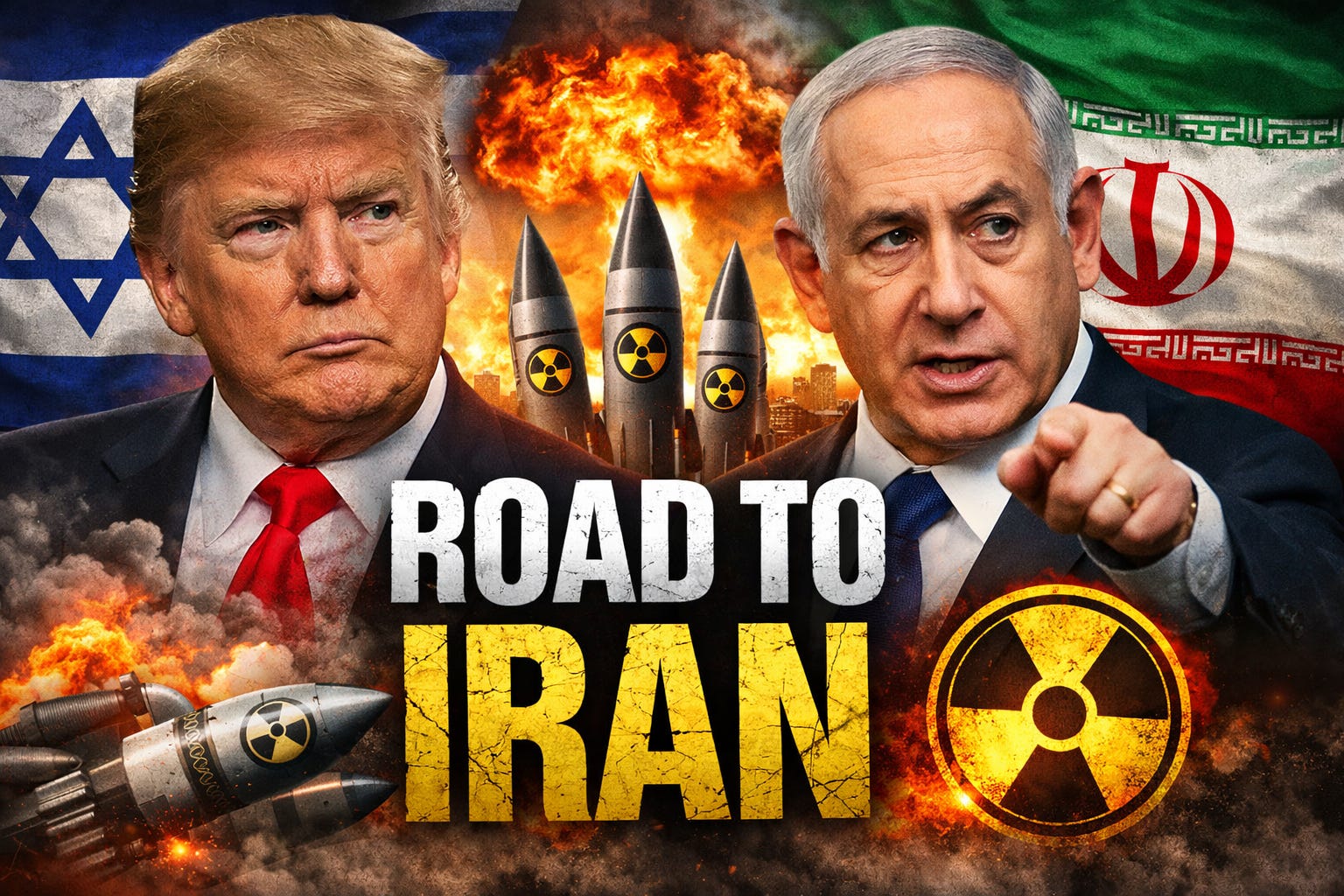
HOW WE GOT HERE: THE LONG ROAD TO IRAN
A look at the events, decisions, and patterns that led here
For over 30 years, we’ve been told the same thing:
Iran is months away from a nuclear weapon.
That warning didn’t start recently. It goes back to the 1990s. And it’s been repeated consistently by Benjamin Netanyahu and others ever since.
Yet here we are.
Still hearing the same timeline. Still being told the same urgency.
So the real question is:
If Iran has been “months away” for decades… what’s actually going on?
THIS DIDN’T START TODAY
To understand the current conflict, you have to go back.
In 1996, a policy paper titled
A Clean Break: A New Strategy for Securing the Realm
was written for Netanyahu by a group of U.S. and Israeli-aligned strategists.
The core idea was simple:
Stop negotiating. Start reshaping the region.
The document outlined removing hostile governments and restructuring the Middle East in a way that favored Israeli security and dominance.
The countries identified as problems?
Iraq. Syria. Lebanon. And ultimately, Iran.
A Clean Break: A New Strategy for Securing the Realm PDF
THEN CAME THE WARS
After 9/11, something happened that lines up closely with that framework.
In a now widely circulated interview, Wesley Clark said he was told the U.S. planned to take out multiple countries in sequence:
Iraq, Syria, Libya, Somalia, Sudan… and Iran.
Whether you believe that was a formal plan or not, look at what actually happened:
Iraq — invaded in 2003
Libya — collapsed in 2011
Syria — destabilized for over a decade
Iran?
Still standing.
THE IRAQ PRECEDENT
The Iraq War was sold on one central claim:
Weapons of Mass Destruction.
They weren’t found.
That matters, because it established something important:
A major war can be justified with claims that don’t hold up later.
So when new threats are presented, it’s not unreasonable to ask harder questions.
THE NUCLEAR NARRATIVE
For decades, the messaging around Iran has been consistent:
They’re close. Very close.
But “close” has stretched across multiple administrations, multiple intelligence assessments, and multiple geopolitical shifts.
That doesn’t automatically mean the threat isn’t real.
But it does raise a fair question:
Why has the timeline never changed?
THE DEAL THAT PAUSED IT
In 2015, the U.S. and several global powers signed the
Joint Comprehensive Plan of Action (JCPOA)
The goal was straightforward:
Limit Iran’s nuclear program
Enforce inspections
Ease sanctions in return
It wasn’t perfect, but it created a framework for containment without war.
THE OPPOSITION
Netanyahu strongly opposed the deal.
His argument was that it delayed Iran, but didn’t stop it.
From a strategic perspective, there’s another way to look at it:
Diplomacy slows momentum.
And if your long-term objective is regime change, slowing things down isn’t helpful.
TRUMP: THE SHIFT
Before becoming president, Donald Trump said something interesting in 2011:
He warned that Barack Obama might start a war with Iran to get reelected.
He also criticized the Iraq War.
At the time, that positioned him as skeptical of Middle East intervention.
But later, as president:
He withdrew from the JCPOA in 2018
Reinstated sanctions
Escalated pressure on Iran
That shift matters.
THE ESCALATION POINT
After the U.S. withdrew from the JCPOA in 2018, tensions didn’t just rise — they accelerated.
In January 2020, the U.S. carried out a drone strike that killed
Qasem Soleimani, one of Iran’s most powerful military leaders.
Soleimani wasn’t just another official. He was the head of Iran’s Quds Force and widely seen as the architect of Iran’s regional strategy.
The strike marked a major shift:
First direct U.S. assassination of a top Iranian military figure
Immediate escalation between the U.S. and Iran
Brought both countries to the brink of open conflict
This moment matters because it sits directly in the sequence:
Deal in place (JCPOA)
Deal removed
Pressure increased
Then a targeted killing of a top Iranian general
At that point, the conflict was no longer just economic or diplomatic.
It had crossed into direct military action.
THE CONTRADICTIONS
Trump’s messaging on foreign policy hasn’t always been consistent.
In a past interview with Barbara Walters, he repeatedly said the U.S. should “take the oil.”
When pressed on how that would happen, including whether it would require war, he didn’t give a clear answer.
At other times, he warned against unnecessary wars in the Middle East.
Then, as president, his policies increased tension with Iran.
You can interpret that a few different ways.
But at minimum, it shows a pattern:
Rhetoric and outcomes don’t always match.
THE PATTERN
When you step back, a sequence starts to form:
1996 — Clean Break outlines regional restructuring
2003 — Iraq invaded (WMD claim later disproven)
2011 — Trump warns about Iran war
2015 — JCPOA attempts diplomacy
2018 — U.S. withdraws, pressure resumes
2020 — Soleimani assassination
Today — Iran remains the central focus
That doesn’t prove a single coordinated plan.
But it does suggest something more than random events.
WHAT ABOUT THE MORE CONTROVERSIAL CLAIMS?
Some people argue there are deeper forces at play.
You’ll hear claims about:
Long-term regional dominance strategies
Political pressure shaping U.S. decisions
Even allegations of blackmail or leverage influencing leaders
Here’s the reality:
Those claims are not proven.
And they should be treated as speculation, not fact.
But they exist because people are trying to explain a pattern that doesn’t always line up cleanly on the surface.
SO WHERE DOES THAT LEAVE US?
Iran is still standing.
Still sanctioned.
Still at the center of global tension.
After decades of warnings, pressure, and conflict around it.
So the real question isn’t just about Iran.
It’s about everything that led up to this moment.
Was this the natural result of evolving threats…
Or the continuation of a long-term strategy that’s been playing out for decades?
FINAL THOUGHT
If a country is always “next”…
If the justification keeps repeating…
And if the players keep changing, but the outcome stays the same…
At some point, it’s worth asking:
Is this policy… or is it pattern?
References
A Clean Break: A New Strategy for Securing the Realm (1996) – Policy paper prepared for Israeli Prime Minister Benjamin Netanyahu outlining strategic recommendations for regional policy
https://www.iasps.org/strat1.htmWesley Clark interview (2007) – Discussion of post-9/11 Pentagon plans involving multiple Middle Eastern countries
Iraq War and Weapons of Mass Destruction findings:
Iraq Survey Group Report (2004) – Found no active WMD stockpiles
https://www.cia.gov/library/reports/general-reports-1/iraq_wmd_2004/U.S. Senate Intelligence Committee Report (2004)
https://www.intelligence.senate.gov/sites/default/files/publications/108301.pdf
Joint Comprehensive Plan of Action (2015) – Full agreement text and framework
https://www.state.gov/the-joint-comprehensive-plan-of-action-jcpoa/Benjamin Netanyahu speeches and statements on Iran’s nuclear program (multiple years):
United Nations General Assembly Speech (2012)
Donald Trump statements and interviews:
Barbara Walters interview (2011)
Public statements and social media posts on Iraq and Iran (archived):
U.S. withdrawal from JCPOA (2018):
https://trumpwhitehouse.archives.gov/briefings-statements/remarks-president-trump-joint-comprehensive-plan-action/Qasem Soleimani assassination (2020):
U.S. Department of Defense statement
https://www.defense.gov/News/Releases/Release/Article/2049534/statement-by-the-department-of-defense/Congressional Research Service report
https://crsreports.congress.gov/product/pdf/IF/IF11403


